
Your first night passage often feels like an anxious guessing game. Points of light appear on the horizon, they move, change colour, then vanish behind a swell. Is it a cargo ship bearing down on you or a trawler lying still? Coming toward you or drawing away? Ashore, a red light tells you to stop; at sea, a red light mostly tells you which side of the vessel you are looking at. That is the whole logic of navigation lights, and it is well worth learning.
The good news is that this language is precisely codified by the COLREGs (the International Regulations for Preventing Collisions at Sea, known in France as the RIPAM). A handful of colours, a few vertical arrangements, and you can read a night scene almost as clearly as by day. This guide breaks down what each light means, how to deduce a vessel's course, and how to avoid the interpretation mistakes that cost the most.
The principle: lights that carve the horizon into sectors
The founding idea is brilliantly simple. Every vessel carries lights that are only visible within a precise angular sector. Depending on the colour you see, you instantly know from what angle you are looking at that vessel — and therefore where it is heading.
Three lights define the picture of a vessel underway:
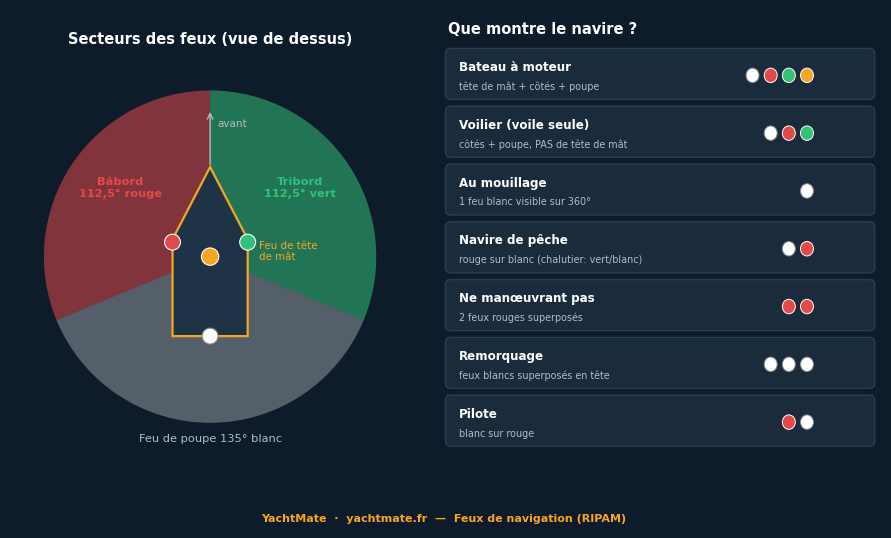
- Starboard sidelight (green): visible from ahead to 112.5° on the right side of the vessel. If you see green, you are on its starboard side.
- Port sidelight (red): the mirror image, 112.5° on the left side. Red = you are on that vessel's port side.
- Sternlight (white): 135° toward the rear. A single low white light means you are looking at its stern: it is moving away.
Add them up: 112.5 + 112.5 + 135 = 360°. The sectors close perfectly around the vessel, with no gap and no overlap. On top of this, a power-driven vessel adds one or two masthead lights (white) visible ahead over 225°. A high white light seen from the front is the signature of a vessel under engine power.
Remember the road-rule mnemonic: "Green to green or red to red, perfect safety, go ahead." If you cross another vessel and each of you shows the other your green light (you see its red, it sees your red), the courses are diverging cleanly.
Reading course and danger at a glance
Once the colours make sense, the exercise becomes situation reading. Here are the cases you will meet most often at sea at night.
You see only white
A lone white light, with no green or red visible, usually means you are looking at the stern of a vessel moving away — or a boat at anchor. It is the most reassuring configuration, provided you check the light is not growing (which would mean it is coming back toward you).
You see red AND green together
This is the one to watch very closely: you are dead ahead of the vessel and it is coming straight at you. Add one or two white lights aligned above and it is a power-driven vessel end-on. A bearing that does not change = risk of collision. Manoeuvre early and boldly.
You see a single side colour
Green alone: the vessel is showing its starboard flank, crossing your course from left to right (at its speed). Red alone: it is crossing from right to left. The steering rules say the vessel that sees the other on its own starboard side (that is, sees red) is the give-way vessel and must manoeuvre.
The colour doesn't just tell you where the vessel is: it tells you who must give way. Seeing red on your starboard side is your signal to act.
Sailing vessel or power-driven? The detail that changes everything
The most useful distinction while cruising: a sailing vessel under sail alone NEVER carries a white masthead light ahead. It shows only its sidelights (red/green) and its white sternlight. So if you see red + green without white above, it is a sailing vessel facing you — and it has right of way over a power-driven vessel.
Conversely, the moment a sailing yacht starts its engine, it legally becomes a "power-driven vessel" and must switch on its masthead light. Many boaters forget this: under engine at night, turn the white masthead light back on. Some yachts carry an optional tricolour light at the masthead (red/green/white combined), highly visible from afar — but it is prohibited under engine, where you must revert to the deck-level lights.
Count the white lights aligned vertically ahead of a power-driven vessel: one = vessel under 50 m; two (the higher one aft) = vessel of 50 m or more. From a distance, this "height" gives you an early sense of the ship's size and therefore its potential speed.
The special lights worth knowing
Beyond the three classics, the COLREGs define combinations for vessels you absolutely must keep clear of. Recognizing them avoids nasty surprises.
- At anchor: an all-round white light at the masthead (two white lights for vessels of 50 m and over, one forward, one lower aft). No sidelights: the vessel is not making way.
- Fishing vessel: a red light over a white light, both all-round. A trawler shows green over white. These vessels drag gear and manoeuvre poorly: give them a wide berth.
- Vessel not under command: two red lights in a vertical line, all-round. It is disabled or unable to keep out of the way — the burden is entirely on you.
- Towing: two (or three if the tow exceeds 200 m) white masthead lights in a vertical line, plus a yellow towing light at the stern. Beware the taut, barely visible cable between the tug and its load.
- Pilot vessel: a white light over a red light, all-round.
- Restricted in ability to manoeuvre: red-white-red in a vertical line, typical of dredgers and cable layers.
A handy way to remember the vertical all-round lights: "Red over white, fishing at night; red over red, the captain is dead (in the water); white over red, pilot ahead." Not very academic, but it saves your memory at 3 a.m.
The classic traps of night vision
Recognizing lights also means distrusting your own eyes. A few mistakes come up again and again among recreational sailors:
- Confusing vessel lights with shore lights. A lit coastline, a lighthouse, buoys, a harbour lamp: so many sources that blur the picture. A light that flashes regularly is almost always a navigation mark, not a vessel.
- Underestimating a cargo ship's speed. A container ship at 20 knots goes from "small dot on the horizon" to "very close" in about ten minutes. The compass bearing is your best judge: if it stays constant, a collision is on its way.
- Losing lights in the chop. In a rough sea, lights vanish behind the waves. Never conclude that a boat has disappeared after a single eclipse; wait for several cycles.
- Forgetting your own lights. Before dusk, check that your lights work, including the spare bulb. Being invisible is the worst danger of all.
This is where AIS and a good navigation app become valuable allies: they confirm the name, course and speed of a vessel when your eyes hesitate. But AIS does not replace a visual watch: a small sailboat, a kayak or a netter may well not transmit. Lights remain the first language of the sea at night.
Sail through the night with peace of mind, with YachtMate
Charts, real-time AIS traffic, course and bearings: YachtMate helps you cross-check the information and decide quickly when a light closes in on the horizon.
Discover the appTo go further, read our guides on night sailing, on the COLREG right-of-way rules and on the Automatic Identification System (AIS).