
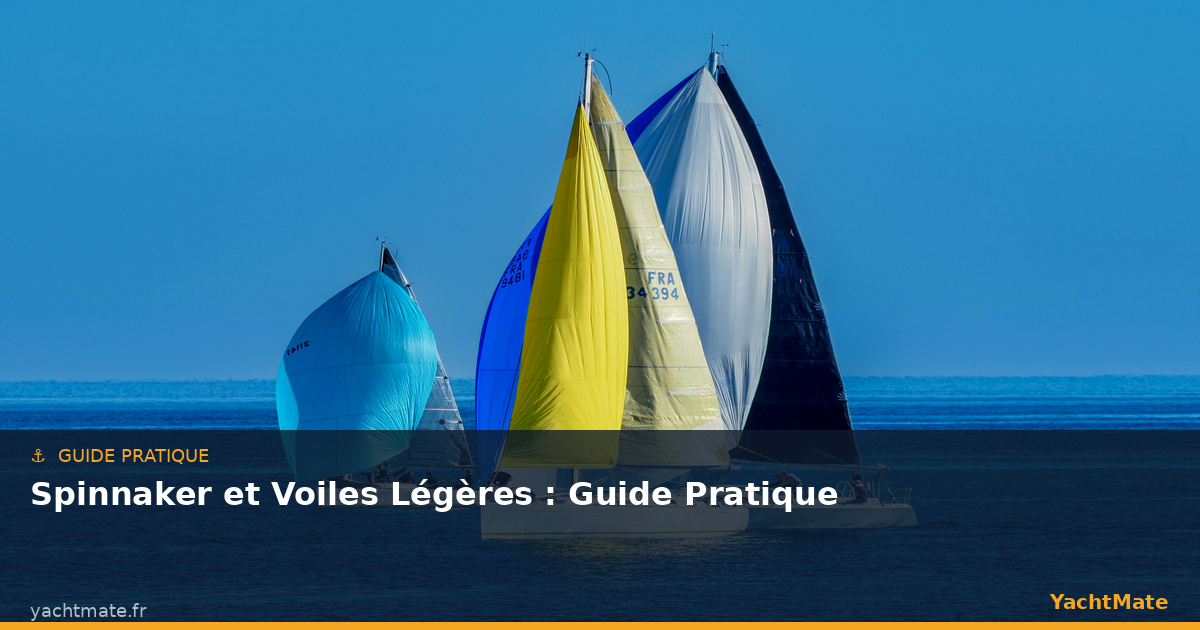
Hoisting a spinnaker for the first time is a milestone moment for any sailor. That colourful cloud of sail billowing ahead of the bow instantly transforms downwind sailing into a thrilling experience. Yet the spinnaker — and its cousins the gennaker and Code 0 — often intimidates less experienced crews. With proper preparation and a solid understanding of the basics, however, these light sails become accessible and devastatingly effective tools.
This guide explains how to choose the right light sail for your conditions, how to hoist and drop it safely, and which mistakes to avoid during manoeuvres. Whether you're sailing the Mediterranean on a summer breeze or running downwind across the Atlantic, you'll find everything you need to get the most from your headsail wardrobe.
Understanding the different light sails
The term "light sail" covers several sail types, each suited to a specific range of wind angles and conditions. Knowing their characteristics helps you make the right choice before leaving the dock.
The symmetric spinnaker
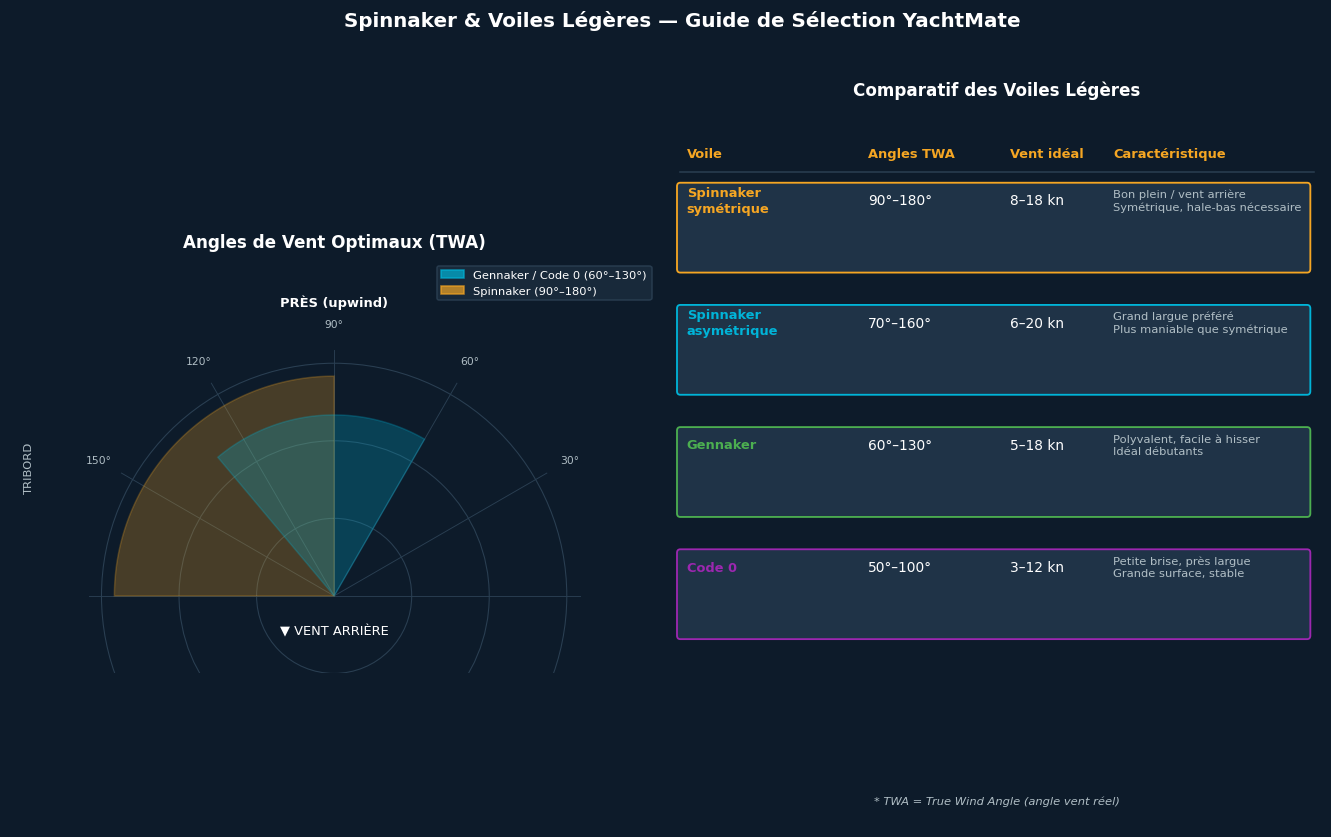
The traditional sail of offshore racing, the symmetric spinnaker is a three-cornered, balloon-shaped sail designed for broad reaching and running (90° to 180° TWA). It requires a spinnaker pole on the windward side to hold the tack under tension. Identical on both sides, it simplifies gybing but demands careful pole management. Ideal wind range: 8 to 20 knots of true wind.
The asymmetric spinnaker
More modern and versatile, the asymmetric spinnaker has a different cut on each side: a concave luff on the windward side, a convex leech to leeward. With no pole, it is flown from a fixed or retractable bowsprit. It covers a broader range, from 70° to 160° TWA, performing best on a broad reach. Gybing is considerably easier than with a symmetric spinnaker.
The gennaker
A hybrid between a genoa and a spinnaker, the gennaker is a versatile and user-friendly sail. Designed for 60° to 130° TWA, it hanks easily to the forestay and suits many cruising yachts. Its intermediate size — between genoa and spinnaker — makes it less powerful than a symmetric spinnaker dead downwind, but far more manageable for a short-handed crew. The ideal stepping stone before moving on to a full spinnaker.
The Code 0
A light-air and reaching sail, the Code 0 shines in light winds (3 to 12 knots) at angles of 50° to 100° TWA. Its large area and flat cut make it perfect for calm days when the genoa is no longer driving the boat. Popular on offshore cruisers, it is often stowed in a sock or on a furling system for easy deployment.
Before you set off, log your sails in the YachtMate inventory with their optimal wind range. While underway, the app displays real-time true wind angle (TWA) so you can choose the right sail without hesitation.
Selecting the right sail for the conditions
The golden rule is simple: true wind angle (TWA) dictates the sail. A quick reference: at a beam reach of 90° TWA, a gennaker or symmetric spinnaker both work well. As you bear away to a broad reach (100°–130°), the asymmetric spinnaker becomes the go-to choice. Dead downwind (150°–180°), a symmetric spinnaker on a pole is unbeatable for raw power. In light air (under 8 knots) and on a close reach (50°–90°), the Code 0 takes over where the genoa gives up.
Wind strength is the second criterion. Above 20 knots of true wind, most light sails become dangerous to handle for inexperienced crews. Douse the sail early: better to be cautious than to wrestle an uncontrolled sail in fresh breeze.
Hoisting the spinnaker: technique and organisation
The key to a successful hoist is preparation. A poorly packed spinnaker invariably produces a twisted hourglass or a torch — embarrassing situations where the sail wraps around itself before it can fill.
Packing ashore or at anchor
The sail should be packed into its sock or deployment bag by feeding it in from the foot while running both sheets through to the cockpit. In racing, a tube-sock retains the sail until the moment of hoisting. Always check that both clews (tack and clew) are free and accessible from the cockpit.
The hoist
Teamwork is essential. One crew member tends the halyard, another the leeward sheet, a third the guy (windward control). The helmsman holds course — ideally dead downwind or on a broad reach so the mainsail shields the spinnaker from disturbed air during the hoist. On command, the halyard goes up quickly and evenly; the sheet is eased at the same rate to avoid leaving the sail flying freely for too long.
Use YachtMate's waypoints and course feature to plan your bear-away before the hoist. Setting a waypoint to leeward gives the crew time to prepare the spinnaker and execute the manoeuvre in good wind and sea conditions.
The drop: the trickiest manoeuvre
Dropping the spinnaker is often more stressful than hoisting it. A full sail exerts enormous pull, and a timing error can result in the sail going overboard. The basic technique is to ease the leeward sheet first to collapse the sail, while one crew member drops the halyard rapidly and another gathers the sail below through the forehatch or companionway.
Gybing with a spinnaker
For a symmetric spinnaker, gybing requires moving the pole from the old windward side to the new. The most common technique is an end-for-end gybe where the pole remains horizontal throughout. For an asymmetric spinnaker, the gybe is simpler: douse the sail briefly in its sock, gybe the mainsail, then rehoist.
When gybing in confused seas, boat stability is reduced. Log the time and conditions of each manoeuvre in the YachtMate logbook to analyse your performance and identify areas for improvement over successive passages.
Common mistakes and how to avoid them
The first mistake is hoisting too late, when the boat is already well into a downwind run in choppy conditions. Prepare the sail well before the planned hoist time. The second classic error is not keeping the mainsail drawing during the hoist: the mainsail shields the spinnaker from turbulence and lets it fill cleanly. Don't sheet it in too early.
When dropping, the typical trap is releasing the halyard before the leeward sheet. The sail then blows out ahead of the boat like a parachute, generating a pull that is very hard to control. Always ease the sheet first, then the halyard. Finally, never leave a light sail hoisted unattended on a boat underway: a sudden wind shift or squall can overpower the rig within seconds.
Care and storage of light sails
Light sails are made from delicate fabrics (nylon, fine polyester, sometimes laminate) that suffer from repeated folding and UV exposure. After each use, rinse the sail with fresh water to remove salt, and allow it to dry completely in the shade before stowing. Avoid folding it in the same places every time: vary the fold lines to extend the fabric's life. An annual check by a sail maker helps identify stress points, fraying seams and worn cringles before they fail at sea.
⛵ Sail smarter with YachtMate
Manage your sail inventory, track real-time wind angle and plan your manoeuvres with the YachtMate app — built for sailors, by sailing enthusiasts.
Discover YachtMate for free