
At sea, breakdowns give no warning. A failing piece of rigging, a sudden hull leak, an engine that won't start when you need to reach port… These situations are part of every sailor's experience, and the difference between a mere anecdote and a life-threatening emergency often comes down to one thing: being prepared. This guide gives you the keys to anticipate the most common failures, build an appropriate repair kit, and act effectively in a crisis.
Why Prepare an Emergency Repair Kit?
The sea has its own rules: far from shore, rescue response times can exceed several hours, and weather conditions sometimes make any assistance impossible. An autonomous sailor is a safe sailor. This means not only knowing the basic procedures, but also having on board the tools and supplies needed to handle the most common situations.
Statistics show that the most common causes of maritime assistance calls are engine failure (38%), hull leaks (12%), and rigging damage (9%) — situations that are largely preventable or manageable with minimal preparation.
Before every departure, check that your repair kit is complete and that consumables (sealants, adhesives, gaskets) haven't expired. An annual inspection is sufficient for most mechanical parts.
The 6 Essential Categories of Your Onboard Kit
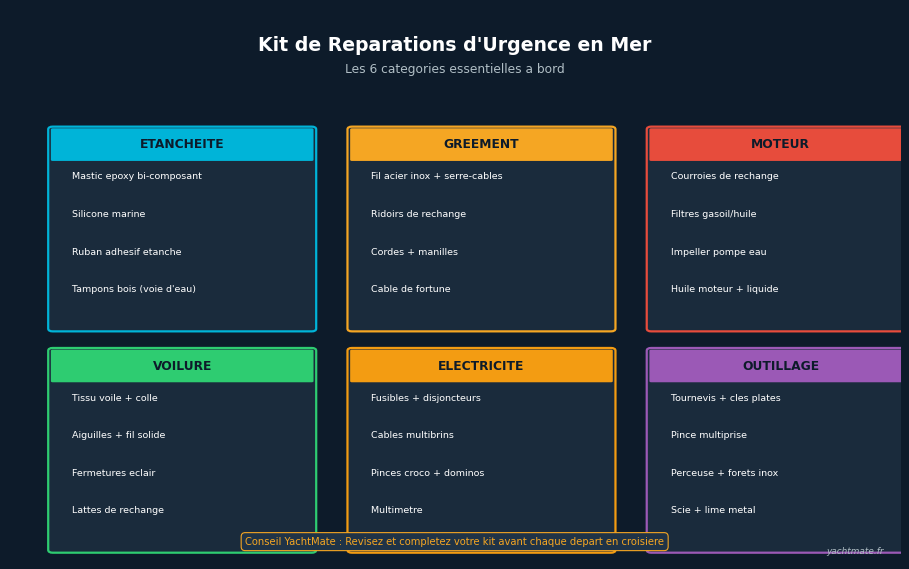
An effective repair kit covers six main areas. Each category addresses a specific type of failure and should be proportional to the distance of your outings — coastal sailing, cruising, or offshore passage-making.
1. Watertight Sealing: Stopping a Hull Leak
A hull leak is the most stressful emergency to manage. First, locate the source: a faulty through-hull fitting, a damaged seacock, or a deteriorated porthole gasket are the most frequent culprits. Your sealing kit must include two-part epoxy putty (effective even underwater), marine silicone, high-resistance waterproof tape, and critically, wooden bungs of various sizes — these allow you to temporarily plug a leak around a through-hull by hammering in a tapered wedge.
2. Rigging: Repairing Under Way
A forestay, shroud, or halyard failure can cause a dismasting. Essential items: stainless steel wire of 4–6 mm with matching wire clamps, spare turnbuckles, an assortment of shackles and lines of various diameters. If the mast is lost, you can improvise jury rig using the remaining boom section and a jib or staysail.
3. Engine: Common Failures
Most engine breakdowns at sea are minor: clogged fuel filter, broken water pump belt, worn impeller. Carry spare belts for your specific engine, fuel and oil filters, one or two water pump impellers, and an oil container. Also consider a diesel bleed kit if your boat has a diesel engine.
4. Sails: Repairing a Tear
A torn sail in a squall can end your cruise if you have nothing to repair it with. The minimum sail kit includes: spinnaker repair tape, a curved sail needle, strong polyester thread, and a few spare battens for the mainsail. For zipper closures on hatches or enclosures, also pack zipper wax and a couple of spare sliders.
5. Electrical: The Essentials
Electrical failures are dreaded because they're often hard to diagnose. Your basic electrical kit: an assortment of fuses and circuit breakers matching your installation, 2.5 mm² and 6 mm² multi-strand cables, terminal blocks, crimp terminals, crocodile clips, and a multimeter. Don't forget a few meters of wire for emergency bypasses.
6. General Toolbox
A basic tool assortment is essential: flat and Phillips screwdrivers in various sizes, open-end and adjustable wrenches, multi-grip pliers and wire cutters, a cordless drill with stainless steel bits, a handsaw and metal file. Add a waterproof flashlight and a headlamp with spare batteries.
Store your kit in waterproof, ventilated containers — ideally compartmentalized polypropylene boxes. Label each box so you can find what you need quickly under stress. Keep mechanical parts separate from chemical products (adhesives, sealants).
Emergency Procedures to Know by Heart
Having the right equipment is good. Knowing how to use it under pressure is better. Here are the four procedures to master before setting out on a cruise.
Handling a Hull Leak
Step 1: immediately activate the bilge pump and assign a crew member to manual pumping in shifts. Step 2: locate the source (inspect through-hulls, seacocks, rudder shaft seals). Step 3: if it's a through-hull, hammer in a tapered wooden bung with a mallet to plug it. Step 4: if the situation is under control, head for the nearest port; if not, activate the distress protocol (VHF channel 16, EPIRB).
Engine Failure Offshore
Don't panic: you have sails. Unfurl the genoa, raise the mainsail if possible, and assess your situation. Start with the simplest causes: fuel level, fuel filter (a clogged filter is enough to stop a diesel), water pump belt. If the engine won't restart, sail to the nearest shelter or request assistance on VHF.
Rigging Loss or Failure
If a shroud breaks, immediately ease pressure on the mast by bearing away (the mast works in compression, not tension). Retrieve the broken shroud and reduce or lower sails. If the mast is still standing, rig an emergency wire from deck or from the mast itself to brace it before cautiously resuming course on a broad reach or downwind.
Damaged Rudder
A broken rudder underway is a real possibility. First solution: steer by sail balance (more forward sail = bear away, more aft sail = head up). Second solution: build a jury rudder using a spinnaker pole or plank lashed to the stern. In all cases, report your situation to the nearest coast guard.
"A good sailor is not one who has never had a breakdown. It's one who knows what to do when it happens."
Preventive Maintenance: The Best Repair
The majority of failures at sea are predictable and avoidable with regular maintenance. Inspect your standing rigging every season (watch for corrosion at turnbuckle tops and chainplates), check through-hull fittings and seacocks (bronze degrades after 10–15 years), replace your water pump impeller every two years even if it looks fine, and monitor your batteries — a failed battery can leave you without radio or navigation.
Use the YachtMate app to schedule your maintenance reminders: impeller, belts, filters, zinc anodes… The app alerts you at the right time so you never head out with equipment at risk.
Repair Kit: Complete Checklist
Here is the base list recommended for coastal sailing (double quantities for offshore use):
- Sealing: two-part epoxy putty, marine silicone, 5 wooden bungs (Ø 12, 20, 32, 40, 50 mm), 50 mm waterproof tape
- Rigging: 3 m stainless wire Ø 5 mm, 6 wire clamps, 2 turnbuckles, 10 stainless shackles, 20 m of 10 mm line
- Engine: alternator + water pump belts, impeller, fuel filter, head gasket (if diesel), 1 L engine oil
- Sails: 50×50 cm spinnaker repair cloth, curved needle, 80 cm thread, 3 spare battens, 2 zip sliders
- Electrical: multimeter, fuse assortment, 5 m 2.5 mm² cable, terminal blocks, crimp terminals, insulating tape
- Tools: screwdriver set, adjustable wrench, Allen key set, multi-grip pliers, waterproof torch, silicone + gun
🧭 Navigate with Confidence Using YachtMate
YachtMate helps you plan your outings, track your maintenance schedule, and access real-time weather information. Never head to sea without your digital co-pilot.
Download YachtMate for Free